
Climate change is inherently interdisciplinary. Connect and collaborate with graduate students with climate change expertise from across the UBC community to deliver climate change-related content in your courses. Browse through the list of available graduate student presenters with expertise in topics such as climate justice, climate economics, climate science, climate and health, and more!
How to Connect
Follow the steps below to have a climate presenter deliver a 50 or 80-minute guest presentation in your course.
Step 1: Fill out a brief (5-minute) questionnaire to identify your topic(s) of interest and teaching schedule. Although optional, you can indicate any preferences from the climate presenters listed below.
Step 2: We'll use your responses to pair you with one or more climate presenters and provide additional information for you to review and select a top choice. We will do our best to accommodate as many requests as possible, but keep in mind that our program budget is limited and that we will try to provide opportunities to as many faculty members from different disciplines as possible.
Step 3: We will contact the climate presenter you selected to confirm their interest and availability. If they can accommodate your request (they will respond within 48 hours), we will send an email to connect you both. You will be asked to provide a course syllabus and to co-identify one or more learning outcomes with the graduate student presenter. We ask that you email them at least two weeks before the presentation date.
Step 4: After the climate presenter has delivered the presentation, we'll send you a short evaluation form.
Browse Climate Presenters
Climate Change, Mental Health and Wellbeing
 Tariq Harney
Institute for Resources, Environment and Sustainability - Faculty of Science
Tariq is a PhD student at the Institute for Resource Environment and Sustainability at UBC. His research examines how communities in Sicily, Italy, narrate their affective/emotional experiences of water. Tariq holds a Masters of Anthropology from the University of Toronto, where he sought to combine his interests in climate justice, language, politics, and community. Tariq’s interest in climate justice and language comes from his own lived experiences as an immigrant in Australia and Italy, where he found community and learned new languages through food and hockey. Tariq combines his experience in climate justice and passion for language and storytelling in his role as Chief Research Officer at the climate education non-profit Break The Divide, which addresses the growing isolation and hopelessness Canadian youth feel about environmental futures through climate mental health education focused on building emotional resilience by strengthening community bonds.
 Rishika Selvakumar
Interdisciplinary Studies - Faculty of Graduate and Postdoctoral Studies
Rishika Selvakumar is a PhD researcher at the University of British Columbia whose work focuses on youth mental health, health economics, and the impacts of climate change on population wellbeing. Her research examines how health systems and mental health are impacted by emerging issues, including climate change and emerging technologies such as AI, with a particular focus on equity, system performance, and climate justice. She uses mixed methods approaches and draws on interdisciplinary training in sustainability, public health, economics, and ethics.
Rishika is currently a Health System Impact Fellow with the Canadian Mental Health Association (CMHA-BC), where she contributes to strengthening mental health systems and advancing evidence-informed policy and practice. Alongside her doctoral work, she has held roles across academia, government, and health systems, including with Fraser Health’s Planetary Health team, where she supported initiatives on sustainable healthcare, air quality, and system adaptation to climate impacts. She has also contributed to policy and program work with Fisheries and Oceans Canada, municipal government in Richmond, and provincial health organizations.
Her climate-related work spans climate change and health economics, mental health impacts of climate change (including eco-anxiety), and health system resilience and adaptation. She has worked with the UBC Climate Hub on climate justice initiatives focused on Indigenous land and data sovereignty, and with community organizations such as Anxiety Canada, where she supported youth engagement and climate anxiety initiatives.
Rishika has extensive experience in teaching and knowledge translation, supporting interdisciplinary learning across health, policy, and professional programs at UBC. She has received multiple recognitions for leadership and community impact, including the BC Achievement Foundation Emerging Leader Award and the Government of British Columbia Medal of Good Citizenship.
Through her work, Rishika brings a systems-oriented and practice-grounded perspective to understanding and addressing the complex intersections of climate change, health systems, and mental wellbeing.
 Esther Roorda
Electrical and Computer Engineering - Faculty of Applied Science
I am PhD Candidate in Electrical and Computer Engineering, where my research explores interdisciplinary strategies to develop more sustainable models of computing through education, community and design, focusing in particular on repair.
The computing industry is involved in escalating environmental problems, from the staggering computational requirements and ethical implications of widespread machine learning to fast-growing rates of e-waste production. These are socio-technical problems, involving technical design, economic models, consumer behaviors and policy. My perspective is that effective interdisciplinary sustainability education is key to addressing these types of sociotechnical challenges, and my current research focus is the integration of sustainability into the engineering curriculum. My work also explores repair as a concrete community-based form of climate action, and a way of practicing critical hope in a changing climate.
As a UBC Public Scholar, I am committed to community-engaged sustainability education and research. This approach is informed by my work as a CoLead of the Digital Tattoo Project (a digital literacy collaboration between UBC and UofT), and several years volunteering and teaching digital-literacy skills at the UBC Learning Exchange. I am also a graduate of UBC CTLT’s Certificate of Advanced Teaching and Learning program, and I facilitate CTLT Instructional Skills workshops.
Climate Change Adaptation

Charlotte Taylor
School of Community and Regional Planning - Faculty of Applied Science
Charlotte Taylor (she/they) is a community-based energy researcher, climate justice educator, and advocate for equitable climate governance based in Vancouver, Canada. She holds a BA in Interdisciplinary Studies with a focus on Climate Change in Media, has completed her MA in Planning with research on community‑led renewable energy development in Canada, and is beginning her PhD in Planning focused on West Coast community energy planning at the University of British Columbia, situated on the unceded homelands of the xʷməθkʷəy̓əm (Musqueam) people. Her research examines the social and institutional conditions shaping community-led renewable energy in BC, with an emphasis on energy justice, participatory governance, and local resilience. Charlotte currently works as a Graduate Research Assistant to Dr. Holly Caggiano at the PLACE (Planning for Climate Equity) Lab, focused on equitable energy transitions, and as a Graduate Academic Assistant to Dr. Pasang Yangjee Sherpa at the Sherpa Lab at UBC, where she has contributed to the Knowledge Justice Collective’s work on Indigenous Knowledge in global climate assessments. She previously coordinated the Climate Justice Study Collective and supported the integration of climate curriculum as the Academic Advocacy Lead at UBC's Climate Hub. Charlotte is committed to advancing just, community-centred climate solutions through research, education, and public engagement.
 Marina Tornorsam
Geography - Faculty of Arts
Marina is a MSc student in the department of Geography focusing on the intersection of fire, livelihoods and community health using interdisciplinary approaches including remote sensing. She earned an MSc in Environmental Biology at Mahidol University and completed her BSc in Environmental Studies at the University of California Santa Barbara with an emphasis in ecology. Her previous work has centered on community-based natural resource management, fire dynamics and ecosystem services across Southeast Asia, where she collaborated with local, regional and global partners to strengthen participatory approaches towards climate adaptation. She has experience as a co-designer and facilitator for technical and non-technical training workshops on a variety of topics from gender equality and social inclusion to community-based fire management, and she has led initiatives in research, community-led monitoring, restoration and environmental education. These experiences have deepened her passion and commitment to bridging scientific knowledge with traditional knowledge towards practical, community-led solutions.
Esther Roorda
Electrical and Computer Engineering - Faculty of Applied Science
I am PhD Candidate in Electrical and Computer Engineering, where my research explores interdisciplinary strategies to develop more sustainable models of computing through education, community and design, focusing in particular on repair.
The computing industry is involved in escalating environmental problems, from the staggering computational requirements and ethical implications of widespread machine learning to fast-growing rates of e-waste production. These are socio-technical problems, involving technical design, economic models, consumer behaviors and policy. My perspective is that effective interdisciplinary sustainability education is key to addressing these types of sociotechnical challenges, and my current research focus is the integration of sustainability into the engineering curriculum. My work also explores repair as a concrete community-based form of climate action, and a way of practicing critical hope in a changing climate.
As a UBC Public Scholar, I am committed to community-engaged sustainability education and research. This approach is informed by my work as a CoLead of the Digital Tattoo Project (a digital literacy collaboration between UBC and UofT), and several years volunteering and teaching digital-literacy skills at the UBC Learning Exchange. I am also a graduate of UBC CTLT’s Certificate of Advanced Teaching and Learning program, and I facilitate CTLT Instructional Skills workshops.
 Amandeep Singh
College of Graduate Studies - UBC Okanagan
Amandeep Singh is professionally a veterinarian and currently a sustainability scholar advancing his expertise as a PhD student in the Interdisciplinary Graduate Studies (IGS)—Sustainability program at the University of British Columbia. His doctoral research at the Food Systems PRISM Lab is dedicated towards developing actionable pathways to achieve net-zero emissions in the Canadian egg industry by 2050, bridging critical gaps between practice and climate policy, using life cycle assessment (LCA) as core methodology.
Prior to his doctoral studies, Amandeep amassed over six years of impactful work in India as an Assistant Professor of Veterinary Extension and as a Veterinary Assistant Surgeon. In these roles, he established himself as a prolific expert, authoring more than 50 scholarly publications, and earning 12 research grants. His career has been characterized by a deep commitment to applied science, leading to the development of vital resources for the farming community, including digital tools like mobile applications, online courses, and comprehensive information and expert systems.
This unique trajectory, from frontline veterinary service and academic leadership in extension education to cutting-edge sustainability science, equips him with an unparalleled interdisciplinary perspective. His passion lies in applying systems thinking and robust data analysis to promote sustainable, climate-resilient food systems. Outside of the lab, he enjoys exploring the Okanagan outdoors, writing poetry, watching documentaries, and connecting with diverse communities.
Climate Change Economics

Chloé Boutron
Political Science - Faculty of Arts
Chloé is a PhD candidate in the Department of Political Science. Her research focuses on the politics of climate policy in fossil fuel-exporting democracies, particularly economic climate policy instruments (e.g., carbon pricing, fossil fuel subsidy reform). Before starting her PhD, Chloé worked to assist ministries of finance in Europe as they sought to incorporate climate change considerations in their decision-making processes.

Nicolas Viens
Sociology - Faculty of Arts
Nicolas Viens is a Ph.D. candidate at the University of British Columbia. His doctoral dissertation examines the political economy of decarbonization, with a focus on state climate governance and its ties with financial and other non-state actors. His research analyzes how public institutions, financial actors, and social groups interact in the development of low-carbon infrastructure and climate-related investments. He explores what these governance arrangements mean for responding to climate change and related environmental challenges, as well as for issues of democratic accountability, inequality, and power imbalances. His work combines environmental and political sociology to highlight key social and ecological challenges within state-led decarbonization initiatives and to identify pathways toward transformative and equitable energy transitions. Nicolas also seeks to bridge academic research and climate policy work; he is involved in policy research on climate governance and active in independent research institutes, particularly by crossing geographic and linguistic barriers in Canada.
Rishika Selvakumar
Interdisciplinary Studies - Faculty of Graduate and Postdoctoral Studies
Rishika Selvakumar is a PhD researcher at the University of British Columbia whose work focuses on youth mental health, health economics, and the impacts of climate change on population wellbeing. Her research examines how health systems and mental health are impacted by emerging issues, including climate change and emerging technologies such as AI, with a particular focus on equity, system performance, and climate justice. She uses mixed methods approaches and draws on interdisciplinary training in sustainability, public health, economics, and ethics.
Rishika is currently a Health System Impact Fellow with the Canadian Mental Health Association (CMHA-BC), where she contributes to strengthening mental health systems and advancing evidence-informed policy and practice. Alongside her doctoral work, she has held roles across academia, government, and health systems, including with Fraser Health’s Planetary Health team, where she supported initiatives on sustainable healthcare, air quality, and system adaptation to climate impacts. She has also contributed to policy and program work with Fisheries and Oceans Canada, municipal government in Richmond, and provincial health organizations.
Her climate-related work spans climate change and health economics, mental health impacts of climate change (including eco-anxiety), and health system resilience and adaptation. She has worked with the UBC Climate Hub on climate justice initiatives focused on Indigenous land and data sovereignty, and with community organizations such as Anxiety Canada, where she supported youth engagement and climate anxiety initiatives.
Rishika has extensive experience in teaching and knowledge translation, supporting interdisciplinary learning across health, policy, and professional programs at UBC. She has received multiple recognitions for leadership and community impact, including the BC Achievement Foundation Emerging Leader Award and the Government of British Columbia Medal of Good Citizenship.
Through her work, Rishika brings a systems-oriented and practice-grounded perspective to understanding and addressing the complex intersections of climate change, health systems, and mental wellbeing.
 Chunyu Pan
Forest Resources Management - Faculty of Forestry and Environmental Stewardship
Chunyu Pan is a PhD Candidate in the Faculty of Forestry & Environmental Stewardship at the University of British Columbia. His research focuses on climate change mitigation, forest and bamboo carbon sequestration, nature-based solutions, life cycle assessment, and carbon markets. He has experience guest lecturing on climate change, forest carbon credits, carbon markets, and nature-based solutions in interdisciplinary academic settings. He has also engaged with international climate policy through his internship with the UNFCCC Secretariat as well as multiple attendances of COP conferences. Chunyu enjoys helping students connect climate science with real-world policy, economics, and sustainability challenges across different fields.
Climate Change Science

Julia Ruth
Curriculum Studies - Faculty of Education
Julia Ruth is a scientist, AI trainer, and educator who specializes in making climate science relatable for diverse audiences. With a unique background spanning topical climate change research, classroom teaching, and artificial intelligence innovation, she is passionate about transforming complex scientific concepts into engaging, accessible, and meaningful learning experiences.
A current PhD student in the Department of Curriculum and Pedagogy, she holds a Master of Science in Earth Science and a Bachelor of Science in Physics, and has conducted climate research with organizations including the National Oceanic and Atmospheric Administration, NASA Goddard Space Flight Center, and the Scripps Institution of Oceanography. Her work has focused on remote sensing, sea ice dynamics, and glaciology, using satellite and field data to better understand Earth’s changing climate.
In addition to research, Julia brings extensive teaching experience across formal and informal settings. She has taught middle school science full-time, developed interdisciplinary climate change curriculum, and created original courses in physics, astronomy, and earth science. Her teaching emphasizes critical thinking, real-world data, and interdisciplinary connections that help students see the relevance of science in their everyday lives.
Beyond the classroom, Julia trains various generative artificial intelligence models in physics and Earth science. She has been contracted to test models, including ChatGPT and Grok, for scientific inaccuracies to further improve the capabilities of these models. These opportunities have instilled in her a passion for AI. Julia is dedicated to empowering students to think critically about climate science and to see themselves as active participants in shaping a more sustainable future.
Nicolas Viens
Sociology - Faculty of Arts
Nicolas Viens is a Ph.D. candidate at the University of British Columbia. His doctoral dissertation examines the political economy of decarbonization, with a focus on state climate governance and its ties with financial and other non-state actors. His research analyzes how public institutions, financial actors, and social groups interact in the development of low-carbon infrastructure and climate-related investments. He explores what these governance arrangements mean for responding to climate change and related environmental challenges, as well as for issues of democratic accountability, inequality, and power imbalances. His work combines environmental and political sociology to highlight key social and ecological challenges within state-led decarbonization initiatives and to identify pathways toward transformative and equitable energy transitions. Nicolas also seeks to bridge academic research and climate policy work; he is involved in policy research on climate governance and active in independent research institutes, particularly by crossing geographic and linguistic barriers in Canada.
 Cassandra Chanen
Earth, Ocean and Atmospheric Sciences - Faculty of Science
Cassandra is a PhD student in Atmospheric Science studying Antarctic climate variability over the past 2000 years. As a paleoclimate scientist, her work places anthropogenic climate change in context of long-term natural variability. Her doctoral research uses circulation modes generated from climate model data and ice-core proxy data to improve reconstructions of temperature and precipitation on the continent. She has a strong background in climate and atmospheric physics and is experienced at communicating climate science to a wide range of audiences.
She is also interested in drawing connections between climate science, climate data and environmental justice. How can we leverage climate data for social change? How do different forms of data illuminate (or obscure) environmental harm? She holds a Master of Environment and Sustainability from the University of Toronto, where she studied data practices in municipal government and worked on participatory mapping projects weaving climate data with oral histories.
Climate Justice
Nicolas Viens
Sociology - Faculty of Arts
Nicolas Viens is a Ph.D. candidate at the University of British Columbia. His doctoral dissertation examines the political economy of decarbonization, with a focus on state climate governance and its ties with financial and other non-state actors. His research analyzes how public institutions, financial actors, and social groups interact in the development of low-carbon infrastructure and climate-related investments. He explores what these governance arrangements mean for responding to climate change and related environmental challenges, as well as for issues of democratic accountability, inequality, and power imbalances. His work combines environmental and political sociology to highlight key social and ecological challenges within state-led decarbonization initiatives and to identify pathways toward transformative and equitable energy transitions. Nicolas also seeks to bridge academic research and climate policy work; he is involved in policy research on climate governance and active in independent research institutes, particularly by crossing geographic and linguistic barriers in Canada.
Charlotte Taylor
School of Community and Regional Planning - Faculty of Applied Science
Charlotte Taylor (she/they) is a community-based energy researcher, climate justice educator, and advocate for equitable climate governance based in Vancouver, Canada. She holds a BA in Interdisciplinary Studies with a focus on Climate Change in Media, has completed her MA in Planning with research on community‑led renewable energy development in Canada, and is beginning her PhD in Planning focused on West Coast community energy planning at the University of British Columbia, situated on the unceded homelands of the xʷməθkʷəy̓əm (Musqueam) people. Her research examines the social and institutional conditions shaping community-led renewable energy in BC, with an emphasis on energy justice, participatory governance, and local resilience. Charlotte currently works as a Graduate Research Assistant to Dr. Holly Caggiano at the PLACE (Planning for Climate Equity) Lab, focused on equitable energy transitions, and as a Graduate Academic Assistant to Dr. Pasang Yangjee Sherpa at the Sherpa Lab at UBC, where she has contributed to the Knowledge Justice Collective’s work on Indigenous Knowledge in global climate assessments. She previously coordinated the Climate Justice Study Collective and supported the integration of climate curriculum as the Academic Advocacy Lead at UBC's Climate Hub. Charlotte is committed to advancing just, community-centred climate solutions through research, education, and public engagement.
Cassandra Chanen
Earth, Ocean and Atmospheric Sciences - Faculty of Science
Cassandra is a PhD student in Atmospheric Science studying Antarctic climate variability over the past 2000 years. As a paleoclimate scientist, her work places anthropogenic climate change in context of long-term natural variability. Her doctoral research uses circulation modes generated from climate model data and ice-core proxy data to improve reconstructions of temperature and precipitation on the continent. She has a strong background in climate and atmospheric physics and is experienced at communicating climate science to a wide range of audiences.
She is also interested in drawing connections between climate science, climate data and environmental justice. How can we leverage climate data for social change? How do different forms of data illuminate (or obscure) environmental harm? She holds a Master of Environment and Sustainability from the University of Toronto, where she studied data practices in municipal government and worked on participatory mapping projects weaving climate data with oral histories.
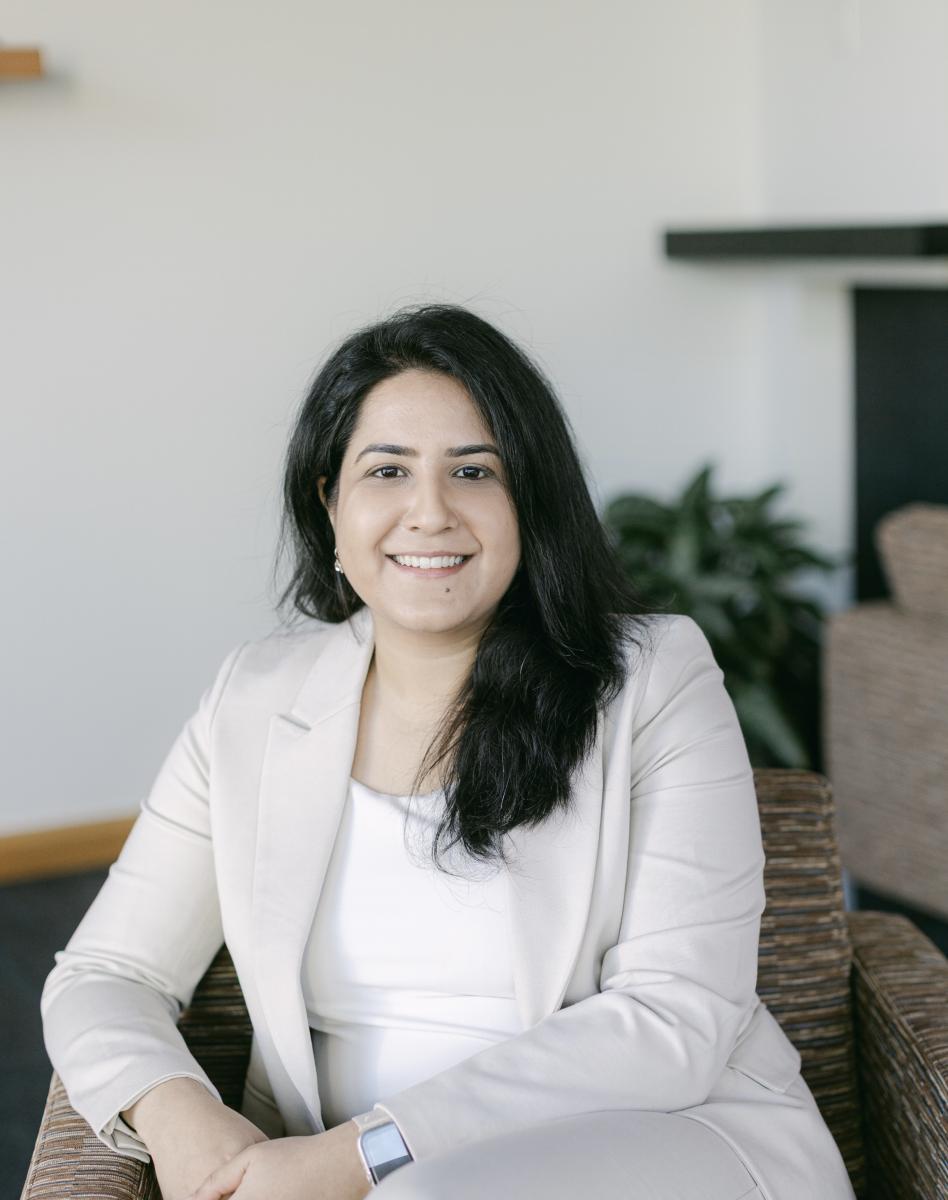 Kirthana Singh Khurana
Peter A. Allard School of Law
Kirthana is a PhD student at the Peter A. Allard School of Law, University of British Columbia. As an Affiliated Research Scholar with the Canada Climate Law Initiative, she authored a Climate Risk and Governance Guide for directors in Canada’s technology sector (2025). She has contributed to emerging scholarship at the intersection of AI and climate governance, including research on algorithmic sustainability and AI-supported emissions measurement and disclosure.
Kirthana has previously worked with the Yale Initiative on Sustainable Finance, Yale Center for Business and the Environment on projects examining corporate net-zero commitments and ESG regulation in the United States. She brings more than 2.5 years of teaching experience as an Assistant Professor and Assistant Dean (Academic Affairs) at Jindal Global Law School and as a Lecturer at Jindal Global Business School, India, where she taught courses on corporate law, securities regulation, corporate social responsibility, and corporate sustainability. At UBC, she has served as a Teaching Assistant in the Law and Society Program within the Faculty of Arts for three terms.
Kirthana holds an LL.M. degree from Yale Law School, a Master of Corporate Law degree from the University of Cambridge, and B.Com (Honours) and LL.B. degrees from the University of Delhi. Her research interests include corporate law, law and technology, AI governance, corporate sustainability, and climate change laws.
 Aida Mohajeri
Department of Educational Studies - Faculty of Education
Aida is a PhD student in Educational Studies and a settler on the traditional, ancestral, and unceded territory of the xʷməθkʷəy̓əm (Musqueam) people. Her dissertation examines higher education, unsustainability, and systemic inequities. She is also a Graduate Research Assistant at the Centre for Climate Justice, contributing to the projects Addressing Intersecting Crises: Climate, Housing, and Compounding Health Vulnerabilities for Senior Tenants and Living with Schizophrenia in a Changing Climate: Housing, Indoor Environmental Quality, and Health Risks. Aida holds an Ed.M. from Harvard University and a BA from Villanova University. Her professional experience spans research, policy, and education in the non-profit and government sectors.
Tariq Harney
Institute for Resources, Environment and Sustainability - Faculty of Science
Tariq is a PhD student at the Institute for Resource Environment and Sustainability at UBC. His research examines how communities in Sicily, Italy, narrate their affective/emotional experiences of water. Tariq holds a Masters of Anthropology from the University of Toronto, where he sought to combine his interests in climate justice, language, politics, and community. Tariq’s interest in climate justice and language comes from his own lived experiences as an immigrant in Australia and Italy, where he found community and learned new languages through food and hockey. Tariq combines his experience in climate justice and passion for language and storytelling in his role as Chief Research Officer at the climate education non-profit Break The Divide, which addresses the growing isolation and hopelessness Canadian youth feel about environmental futures through climate mental health education focused on building emotional resilience by strengthening community bonds.
Climate Change and Law
Chunyu Pan
Forest Resources Management - Faculty of Forestry and Environmental Stewardship
Chunyu Pan is a PhD Candidate in the Faculty of Forestry & Environmental Stewardship at the University of British Columbia. His research focuses on climate change mitigation, forest and bamboo carbon sequestration, nature-based solutions, life cycle assessment, and carbon markets. He has experience guest lecturing on climate change, forest carbon credits, carbon markets, and nature-based solutions in interdisciplinary academic settings. He has also engaged with international climate policy through his internship with the UNFCCC Secretariat as well as multiple attendances of COP conferences. Chunyu enjoys helping students connect climate science with real-world policy, economics, and sustainability challenges across different fields.
Kirthana Singh Khurana
Peter A. Allard School of Law
Kirthana is a PhD student at the Peter A. Allard School of Law, University of British Columbia. As an Affiliated Research Scholar with the Canada Climate Law Initiative, she authored a Climate Risk and Governance Guide for directors in Canada’s technology sector (2025). She has contributed to emerging scholarship at the intersection of AI and climate governance, including research on algorithmic sustainability and AI-supported emissions measurement and disclosure.
Kirthana has previously worked with the Yale Initiative on Sustainable Finance, Yale Center for Business and the Environment on projects examining corporate net-zero commitments and ESG regulation in the United States. She brings more than 2.5 years of teaching experience as an Assistant Professor and Assistant Dean (Academic Affairs) at Jindal Global Law School and as a Lecturer at Jindal Global Business School, India, where she taught courses on corporate law, securities regulation, corporate social responsibility, and corporate sustainability. At UBC, she has served as a Teaching Assistant in the Law and Society Program within the Faculty of Arts for three terms.
Kirthana holds an LL.M. degree from Yale Law School, a Master of Corporate Law degree from the University of Cambridge, and B.Com (Honours) and LL.B. degrees from the University of Delhi. Her research interests include corporate law, law and technology, AI governance, corporate sustainability, and climate change laws.
Climate Change and Artificial Intelligence
Amandeep Singh
College of Graduate Studies - UBC Okanagan
Amandeep Singh is professionally a veterinarian and currently a sustainability scholar advancing his expertise as a PhD student in the Interdisciplinary Graduate Studies (IGS)—Sustainability program at the University of British Columbia. His doctoral research at the Food Systems PRISM Lab is dedicated towards developing actionable pathways to achieve net-zero emissions in the Canadian egg industry by 2050, bridging critical gaps between practice and climate policy, using life cycle assessment (LCA) as core methodology.
Prior to his doctoral studies, Amandeep amassed over six years of impactful work in India as an Assistant Professor of Veterinary Extension and as a Veterinary Assistant Surgeon. In these roles, he established himself as a prolific expert, authoring more than 50 scholarly publications, and earning 12 research grants. His career has been characterized by a deep commitment to applied science, leading to the development of vital resources for the farming community, including digital tools like mobile applications, online courses, and comprehensive information and expert systems.
This unique trajectory, from frontline veterinary service and academic leadership in extension education to cutting-edge sustainability science, equips him with an unparalleled interdisciplinary perspective. His passion lies in applying systems thinking and robust data analysis to promote sustainable, climate-resilient food systems. Outside of the lab, he enjoys exploring the Okanagan outdoors, writing poetry, watching documentaries, and connecting with diverse communities.
Kirthana Singh Khurana
Peter A. Allard School of Law
Kirthana is a PhD student at the Peter A. Allard School of Law, University of British Columbia. As an Affiliated Research Scholar with the Canada Climate Law Initiative, she authored a Climate Risk and Governance Guide for directors in Canada’s technology sector (2025). She has contributed to emerging scholarship at the intersection of AI and climate governance, including research on algorithmic sustainability and AI-supported emissions measurement and disclosure.
Kirthana has previously worked with the Yale Initiative on Sustainable Finance, Yale Center for Business and the Environment on projects examining corporate net-zero commitments and ESG regulation in the United States. She brings more than 2.5 years of teaching experience as an Assistant Professor and Assistant Dean (Academic Affairs) at Jindal Global Law School and as a Lecturer at Jindal Global Business School, India, where she taught courses on corporate law, securities regulation, corporate social responsibility, and corporate sustainability. At UBC, she has served as a Teaching Assistant in the Law and Society Program within the Faculty of Arts for three terms.
Esther Roorda
Electrical and Computer Engineering - Faculty of Applied Science
I am PhD Candidate in Electrical and Computer Engineering, where my research explores interdisciplinary strategies to develop more sustainable models of computing through education, community and design, focusing in particular on repair.
The computing industry is involved in escalating environmental problems, from the staggering computational requirements and ethical implications of widespread machine learning to fast-growing rates of e-waste production. These are socio-technical problems, involving technical design, economic models, consumer behaviors and policy. My perspective is that effective interdisciplinary sustainability education is key to addressing these types of sociotechnical challenges, and my current research focus is the integration of sustainability into the engineering curriculum. My work also explores repair as a concrete community-based form of climate action, and a way of practicing critical hope in a changing climate.
As a UBC Public Scholar, I am committed to community-engaged sustainability education and research. This approach is informed by my work as a CoLead of the Digital Tattoo Project (a digital literacy collaboration between UBC and UofT), and several years volunteering and teaching digital-literacy skills at the UBC Learning Exchange. I am also a graduate of UBC CTLT’s Certificate of Advanced Teaching and Learning program, and I facilitate CTLT Instructional Skills workshops.
Climate Change and Health Systems
Marina Tornorsam
Geography - Faculty of Arts
Marina is a MSc student in the department of Geography focusing on the intersection of fire, livelihoods and community health using interdisciplinary approaches including remote sensing. She earned an MSc in Environmental Biology at Mahidol University and completed her BSc in Environmental Studies at the University of California Santa Barbara with an emphasis in ecology. Her previous work has centered on community-based natural resource management, fire dynamics and ecosystem services across Southeast Asia, where she collaborated with local, regional and global partners to strengthen participatory approaches towards climate adaptation. She has experience as a co-designer and facilitator for technical and non-technical training workshops on a variety of topics from gender equality and social inclusion to community-based fire management, and she has led initiatives in research, community-led monitoring, restoration and environmental education. These experiences have deepened her passion and commitment to bridging scientific knowledge with traditional knowledge towards practical, community-led solutions.
Rishika Selvakumar
Interdisciplinary Studies - Faculty of Graduate and Postdoctoral Studies
Rishika Selvakumar is a PhD researcher at the University of British Columbia whose work focuses on youth mental health, health economics, and the impacts of climate change on population wellbeing. Her research examines how health systems and mental health are impacted by emerging issues, including climate change and emerging technologies such as AI, with a particular focus on equity, system performance, and climate justice. She uses mixed methods approaches and draws on interdisciplinary training in sustainability, public health, economics, and ethics.
Rishika is currently a Health System Impact Fellow with the Canadian Mental Health Association (CMHA-BC), where she contributes to strengthening mental health systems and advancing evidence-informed policy and practice. Alongside her doctoral work, she has held roles across academia, government, and health systems, including with Fraser Health’s Planetary Health team, where she supported initiatives on sustainable healthcare, air quality, and system adaptation to climate impacts. She has also contributed to policy and program work with Fisheries and Oceans Canada, municipal government in Richmond, and provincial health organizations.
Her climate-related work spans climate change and health economics, mental health impacts of climate change (including eco-anxiety), and health system resilience and adaptation. She has worked with the UBC Climate Hub on climate justice initiatives focused on Indigenous land and data sovereignty, and with community organizations such as Anxiety Canada, where she supported youth engagement and climate anxiety initiatives.
Rishika has extensive experience in teaching and knowledge translation, supporting interdisciplinary learning across health, policy, and professional programs at UBC. She has received multiple recognitions for leadership and community impact, including the BC Achievement Foundation Emerging Leader Award and the Government of British Columbia Medal of Good Citizenship.
Through her work, Rishika brings a systems-oriented and practice-grounded perspective to understanding and addressing the complex intersections of climate change, health systems, and mental wellbeing.
Climate Change Communications
Amandeep Singh
College of Graduate Studies - UBC Okanagan
Amandeep Singh is professionally a veterinarian and currently a sustainability scholar advancing his expertise as a PhD student in the Interdisciplinary Graduate Studies (IGS)—Sustainability program at the University of British Columbia. His doctoral research at the Food Systems PRISM Lab is dedicated towards developing actionable pathways to achieve net-zero emissions in the Canadian egg industry by 2050, bridging critical gaps between practice and climate policy, using life cycle assessment (LCA) as core methodology.
Prior to his doctoral studies, Amandeep amassed over six years of impactful work in India as an Assistant Professor of Veterinary Extension and as a Veterinary Assistant Surgeon. In these roles, he established himself as a prolific expert, authoring more than 50 scholarly publications, and earning 12 research grants. His career has been characterized by a deep commitment to applied science, leading to the development of vital resources for the farming community, including digital tools like mobile applications, online courses, and comprehensive information and expert systems.
This unique trajectory, from frontline veterinary service and academic leadership in extension education to cutting-edge sustainability science, equips him with an unparalleled interdisciplinary perspective. His passion lies in applying systems thinking and robust data analysis to promote sustainable, climate-resilient food systems. Outside of the lab, he enjoys exploring the Okanagan outdoors, writing poetry, watching documentaries, and connecting with diverse communities.
Charlotte Taylor
School of Community and Regional Planning - Faculty of Applied Science
Charlotte Taylor (she/they) is a community-based energy researcher, climate justice educator, and advocate for equitable climate governance based in Vancouver, Canada. She holds a BA in Interdisciplinary Studies with a focus on Climate Change in Media, has completed her MA in Planning with research on community‑led renewable energy development in Canada, and is beginning her PhD in Planning focused on West Coast community energy planning at the University of British Columbia, situated on the unceded homelands of the xʷməθkʷəy̓əm (Musqueam) people. Her research examines the social and institutional conditions shaping community-led renewable energy in BC, with an emphasis on energy justice, participatory governance, and local resilience. Charlotte currently works as a Graduate Research Assistant to Dr. Holly Caggiano at the PLACE (Planning for Climate Equity) Lab, focused on equitable energy transitions, and as a Graduate Academic Assistant to Dr. Pasang Yangjee Sherpa at the Sherpa Lab at UBC, where she has contributed to the Knowledge Justice Collective’s work on Indigenous Knowledge in global climate assessments. She previously coordinated the Climate Justice Study Collective and supported the integration of climate curriculum as the Academic Advocacy Lead at UBC's Climate Hub. Charlotte is committed to advancing just, community-centred climate solutions through research, education, and public engagement.
Marina Tornorsam
Geography - Faculty of Arts
Marina is a MSc student in the department of Geography focusing on the intersection of fire, livelihoods and community health using interdisciplinary approaches including remote sensing. She earned an MSc in Environmental Biology at Mahidol University and completed her BSc in Environmental Studies at the University of California Santa Barbara with an emphasis in ecology. Her previous work has centered on community-based natural resource management, fire dynamics and ecosystem services across Southeast Asia, where she collaborated with local, regional and global partners to strengthen participatory approaches towards climate adaptation. She has experience as a co-designer and facilitator for technical and non-technical training workshops on a variety of topics from gender equality and social inclusion to community-based fire management, and she has led initiatives in research, community-led monitoring, restoration and environmental education. These experiences have deepened her passion and commitment to bridging scientific knowledge with traditional knowledge towards practical, community-led solutions.
Chunyu Pan
Forest Resources Management - Faculty of Forestry and Environmental Stewardship
Chunyu Pan is a PhD Candidate in the Faculty of Forestry & Environmental Stewardship at the University of British Columbia. His research focuses on climate change mitigation, forest and bamboo carbon sequestration, nature-based solutions, life cycle assessment, and carbon markets. He has experience guest lecturing on climate change, forest carbon credits, carbon markets, and nature-based solutions in interdisciplinary academic settings. He has also engaged with international climate policy through his internship with the UNFCCC Secretariat as well as multiple attendances of COP conferences. Chunyu enjoys helping students connect climate science with real-world policy, economics, and sustainability challenges across different fields.
Tariq Harney
Institute for Resources, Environment and Sustainability - Faculty of Science
Tariq is a PhD student at the Institute for Resource Environment and Sustainability at UBC. His research examines how communities in Sicily, Italy, narrate their affective/emotional experiences of water. Tariq holds a Masters of Anthropology from the University of Toronto, where he sought to combine his interests in climate justice, language, politics, and community. Tariq’s interest in climate justice and language comes from his own lived experiences as an immigrant in Australia and Italy, where he found community and learned new languages through food and hockey. Tariq combines his experience in climate justice and passion for language and storytelling in his role as Chief Research Officer at the climate education non-profit Break The Divide, which addresses the growing isolation and hopelessness Canadian youth feel about environmental futures through climate mental health education focused on building emotional resilience by strengthening community bonds.
Questions?
Email our program coordinator, Oliver Lane, at oliver.lane@ubc.ca.
Testimonials
"I found it a very straightforward and easy process! I had a great experience working with the Climate Expert and look forward to participating in the program in the future!"
Dr. Sara Elder, Course Instructor and Postdoctoral Fellow, Institute for Resources, Environment and Sustainability
"The Climate Teaching Connector is a great resource linking learners, faculty and researchers with multidisciplinary perspectives and resources needed to inspire, promote and sustain climate awareness and action. My undergraduate students in PLAN 331 (The Just City in a Divided World) learned immensely from our guest Climate Expert who gave rich examples on climate vulnerabilities generated from an under-studied region and connected these insights to our other lessons on urbanization, city justice, urban revitalization, and climate migration grounded on histories of colonialism, militarization, and economic development."
Dr. Leonora C. Angeles, Associate Professor, School of Community and Regional Planning & Institute for Gender, Race, Sexuality, and Social Justice
"I am planning to continue tapping into this incredible connector as I personally believe it fosters not only connection with people, but also creativity and collaboration which is what we really need - an interdisciplinary approach to actually address these complex challenges that come as a result of climate change. I find it very inspiring and I really hope that other faculty reach out because it’s been amazing!"
Raluca Radu, MSN, Faculty Lecturer, Nursing